Calories burned incline walking climb quickly with grade: at 3.5 mph for 30 minutes, a 155 lb person uses about 135 kcal flat and 313 kcal at 10% incline, per an ACSM-based treadmill calculator.
Treat every figure below as an estimate that moves with body weight and pace. For setup basics, read our guide on how to use a fitness tracker, then use the table to sanity-check whatever your device reports.
How a slope raises energy use
Incline walking burns more because higher inclines require more energy and more oxygen, and treadmill calculators turn that oxygen demand into calories in a fixed sequence.
- Speed and grade set the oxygen cost. The ACSM walking equation is VO2 = 0.1 × S + 1.8 × S × G + 3.5, with S in metres per minute and G as a fraction. Grade appears only in the middle term, which multiplies speed by grade. A slope therefore adds more at a faster walking pace than at a slower one.
- Oxygen becomes energy. The calculator converts oxygen uptake at about 5 kcal per litre of oxygen.
- Body weight scales the total. Because the oxygen cost is expressed per kilogram, the same speed and slope cost a heavier walker more calories overall. The table in the next section shows the size of that effect.
The practical lesson is that grade and speed are separate levers. If a steep setting feels too hard, a moderate slope at a steady pace still changes the energy cost a great deal, as the numbers below show.
Calories by incline and body weight
The table lists calories for 30 minutes of walking at the stated settings. The flat and 10% rows use 3.5 mph; the 12-3-30 row uses 12% incline at 3 mph.
| Setting (30 min) | 130 lb | 155 lb | 180 lb | 205 lb | Planning use |
|---|---|---|---|---|---|
| Flat, 0% at 3.5 mph | 114 kcal | 135 kcal | 159 kcal | 180 kcal | Baseline for judging how much a slope adds |
| 10% incline at 3.5 mph | 264 kcal | 313 kcal | 366 kcal | 416 kcal | Shows what grade alone adds at an unchanged speed |
| 12-3-30 (12% incline, 3 mph) | 256 kcal | 304 kcal | 356 kcal | 404 kcal | Shows how a slower speed offsets a steeper grade |
These figures come from the Sport Calculator treadmill calorie calculator, which applies the ACSM walking equation.
Read the table by row first. At 130 lb, moving from flat to 10% incline takes the 30-minute total from 114 to 264 kcal. At 205 lb, the same change takes it from 180 to 416 kcal. Every body weight in the table shows a large jump from the slope, so you do not need to be near the top of the range for incline to matter.
Then read across a row. Within each setting, the total rises steadily with body weight. Comparing your own result with a friend’s is therefore less useful than comparing your own flat and incline sessions, because the gap between them is what the slope earns you.
The 12-3-30 workout
12-3-30 means 12% incline, 3 mph and 30 minutes, and it is effective as a calorie-burning walk: for a 155 lb person the calculator gives about 304 kcal, against about 135 kcal for 30 minutes of flat walking at 3.5 mph.
The worked example in the same calculator puts the session at 8.3 MET, or about 10.1 kcal per minute. Over 30 minutes that is about 304 kcal, of which about 267 kcal is above resting energy use. If you are comparing that active portion with the total on a watch face, Active Calories vs Total Calories: What Really Counts For Weight Loss And Fitness (2026 Guide) – Bioconnected explains why the two numbers differ.
The table adds a useful caveat. At 155 lb, a plain 10% incline at 3.5 mph comes to 313 kcal, slightly more than the 304 kcal for 12-3-30. A steeper grade does not automatically win; the faster pace carries real weight. Choose 12-3-30 if a slower belt speed suits your joints or your breathing, and choose a faster pace on a moderate grade if you would rather keep your stride natural. The evidence here covers energy cost only, so it supports calling the routine an effective calorie burner but says nothing about results beyond that.
Calculating your own number
You can reproduce a calculator’s answer with a short formula, which is useful when your speed or grade does not match a table row.
- Get a MET value for your speed and grade. The ACSM equation above returns oxygen use per kilogram per minute. Dividing by 3.5 gives METs, which is how the 12-3-30 example reaches 8.3 MET.
- Apply the calorie formula. Calories = MET × 3.5 × weight (kg) / 200 × minutes, as set out by Kalo Health’s walking calculator. For uphill walking, that tool’s estimate also uses the ACSM walking equation, so it accounts for speed and grade.
- Check the result against the table. If your answer for a similar weight and slope is far from the table, recheck the units. The formula needs weight in kilograms and time in minutes, while the table uses pounds and miles per hour.
This route suits anyone who walks at a pace between table rows or who wants to see how each variable moves the result. The formula returns the same kind of estimate as the table, not a measurement.
How trackers and watches handle incline
A watch gives an estimate of incline calories, and its accuracy depends on whether the estimate knows about the slope. The treadmill calculator states that its calculation is an estimate and may not be exact for all individuals, and that actual burn varies with fitness level, age and body composition. A wearable faces the same individual differences, so expect it to be approximate.
Three practical checks follow from that.
- Look for grade in the calculation. The ACSM equation includes speed and grade, which is why the table separates flat from 10%. A device that reports a figure close to the flat row during a steep session is likely ignoring the slope. Enter or confirm the incline wherever your device or app allows it.
- Prefer measured time and distance to step counts. Kalo Health notes that its steps mode uses a simple 2,000-steps-per-mile assumption, so entering measured time or distance is better. A step-based estimate rests on a fixed stride and carries no information about grade.
- Compare, do not trust blindly. Look up your weight and incline in the table above and see how far your watch is from it. Use the watch for trends across sessions on the same machine and setting, and treat any single reading as approximate.
If the same device also tracks your nights, Best Free Sleep Tracker Apps In 2026: Improve Your Sleep Without Spending A Dime – Bioconnected compares free options worth trying alongside it.
Setting the treadmill and entering your numbers
Speed and grade both go into the estimate, so set and record both for every session. The calculator treats walking as up to 4 mph (6.4 km/h) and running above that, which means faster sessions should be logged as running, not as steep walking.
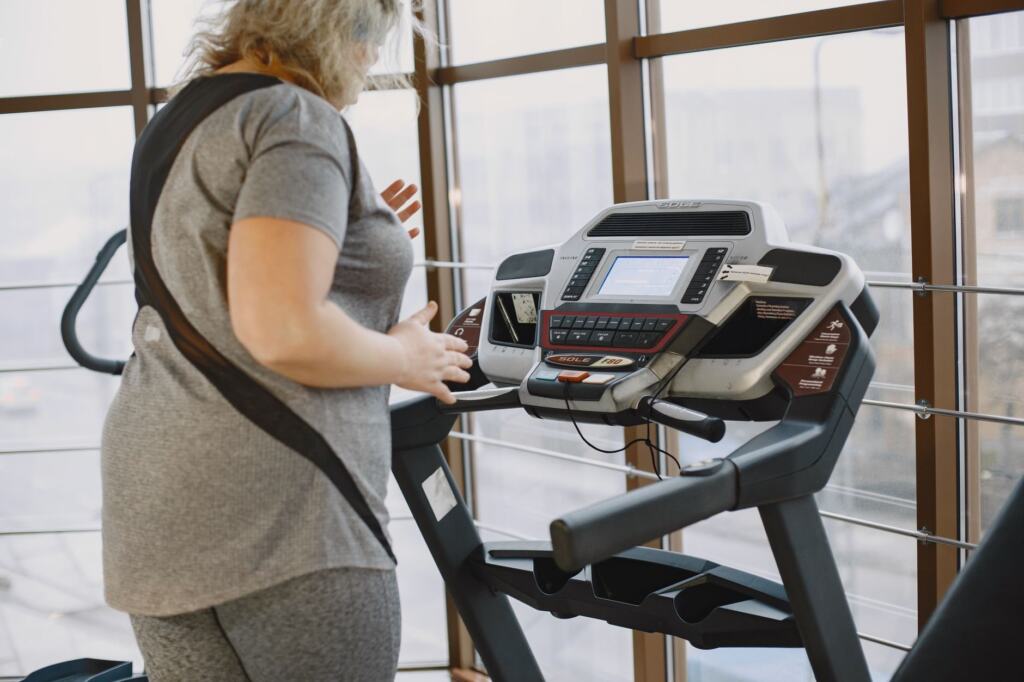
Machines differ in how steep they go. The same source mentions machines that support 15-40% incline training, so check the console range before assuming a setting exists. For a 155 lb walker, the calculator gives 224 kcal for 30 minutes at 5% and 401 kcal at 15%, both at 3.5 mph. That span shows why small steps up matter: each increase in grade moves the total noticeably, so raise it gradually and change one variable at a time. Then you can tell whether it was the slope or the pace that changed your total.
Frequently asked questions
Why do flat-walking calorie figures differ between calculators?
Pace and body weight differ between tools. The treadmill calculator gives about 135 kcal for a 155 lb person walking 30 minutes at 3.5 mph, while Kalo Health puts a brisk flat walk for the same weight at 150-160 kcal. A MET calculator example gives about 129 kcal for 70 kg over 30 minutes, with more for a heavier or faster walker.
Can I estimate incline calories without a heart rate monitor?
Yes. The treadmill calculator is designed to estimate calorie burn without knowing your exact heart rate, using speed, grade and body weight instead.
What is a MET?
A MET is a multiple of resting energy use. According to a MET calculator reference, 1 MET equals 3.5 mL of oxygen per kg per minute, which is resting metabolic rate.