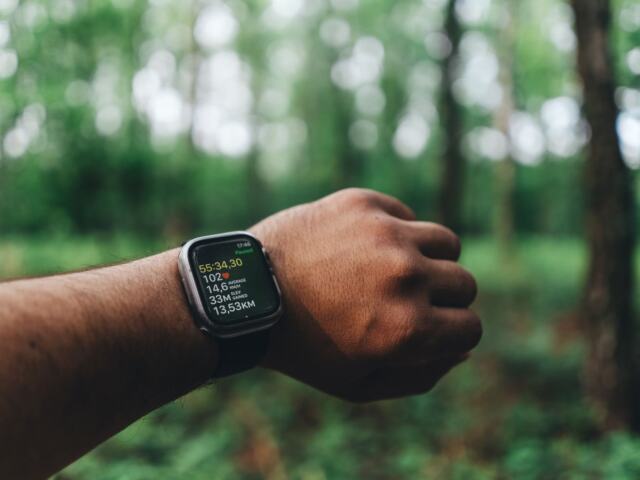
Average VO2 max depends on age and sex, so no single figure is good or bad. Compare your result with your own age and sex group, and treat a watch estimate as a trend line rather than a verdict.
If you are still choosing or setting up a device, start with how to use a fitness tracker. The sections below explain what the number represents, how to place it, and how far a wearable reading can be trusted.
What VO2 max measures
VO2 max is a measure of how much oxygen the body can take in and use during hard exercise, and it is the standard way to score cardiorespiratory fitness. Harvard Health notes that it is typically reported as milliliters of oxygen consumed per kilogram of body weight per minute, written ml/kg/min. The University of Kansas Medical Center uses the same unit and calls VO2 max the gold standard of measurement in aerobic fitness scoring.
The per-kilogram unit has a practical consequence. Two people can use the same total amount of oxygen and still post different scores if their body weights differ. When you compare your number with a friend’s, you are comparing oxygen use relative to body size, not raw engine output.
A raw VO2 max score means little by itself, because it has no built-in reference point. The next section explains how to turn it into something you can act on.
Why there is no single average
Several factors move VO2 max before training even enters the picture. Harvard Health states that age, gender, location elevation, and activity levels all affect your VO2 max score. Because of this, a single national average would mislead most readers. A figure that is typical for one person can be well above or below typical for another.
Age and the long decline
VO2 max tends to decrease as you age. Studies cited by SuperTri suggest a reduction of around 10 percent per decade. Harvard Health adds that staying active can greatly slow the decline. The practical reading is that holding your score steady through your forties and fifties is a real achievement, and an older reader should not judge their number against a twenty-something’s.
Sex differences
Men tend to have higher VO2 max than women, both in absolute terms and relative to body mass, according to the same SuperTri overview. This is the reason any useful chart splits results by sex. A woman comparing her score with a male chart will underrate her fitness.
Turning your score into a percentile
The most useful way to find where you stand is a percentile rank. The University of Kansas Medical Center offers a calculator that converts a VO2 max score to a percentile rank, so people of different ages can be compared. Its algorithm is based on the American College of Sports Medicine (ACSM) Guidelines for Exercise Testing and Prescription, 9th Ed. The university states that the algorithm is currently being peer reviewed and that the results are estimates only. Use the percentile as a guide to your standing, not as a clinical finding.
What counts as above average
Above average means your percentile rank sits higher than the middle of your age and sex group. It does not mean reaching a fixed number. SuperTri puts it plainly: there is no defined good or bad VO2 max value because it is relative to your age and sex.
The same source gives a sense of the ceiling. A high VO2 max might be over 80 ml/kg/min for an elite male endurance athlete and over 65 ml/kg/min for an elite female. Those are the top end of the range, so they are not goals for a recreational runner. A better target is to move up your own percentile band.
Training intensity is one way to move that percentile. Our guide to Heart Rate Zones Explained: A Simple Guide To Training Smarter In 2026 – Bioconnected shows how to plan effort once you know where you stand.
Lab tests and wearable estimates
Direct testing is the benchmark, but it is a specialist procedure. A peer-reviewed study in PubMed Central describes direct gas-analysis testing as requiring maximal effort and as restricted to a well-equipped laboratory environment with technical expertise. The ACSM guidance quoted by the University of Kansas Medical Center says maximal exercise testing should be conducted on a treadmill.

Most people will never take that test, so the useful question is how close cheaper estimates come. The same research team compared a submaximal prediction method with measured VO2 max as ground truth in 517 participants. The table summarises what that comparison shows.
| Method | Effort and setting | Reported accuracy | Planning use |
|---|---|---|---|
| Direct gas-analysis test | Maximal effort in a well-equipped laboratory; ACSM guidance calls for a treadmill | Used as the ground truth in the validation study | Best choice when you need a definitive baseline or a clinical-grade answer |
| Submaximal cycle prediction (Astrand-Rhyming type) | Steady-state heart rate across a 6-minute submaximal test | Mean absolute error 3.12 ml/kg/min; root mean square error 4.24 ml/kg/min; R² 0.83 | Reasonable for tracking and rough placement, but too loose to separate neighbouring percentile bands |
The test descriptions and error figures come from the peer-reviewed validation study, and the treadmill guidance comes from the University of Kansas Medical Center.
How big the error is
A mean absolute error of 3.12 ml/kg/min means the prediction missed the measured value by about that much on average. The root mean square error of 4.24 ml/kg/min weights larger misses more heavily, so it shows that some people were off by more. The fit was also better in younger adults: R² was 0.85 for ages 21 to 40 and 0.75 above 40. If you are over 40, expect a heart-rate-based estimate to be somewhat less dependable.
That study tested a cycle protocol, not a watch. Treat its error as a sign of the scale of error that heart-rate-based estimation can carry, not as a specification for any particular device.
What a watch can and cannot tell you
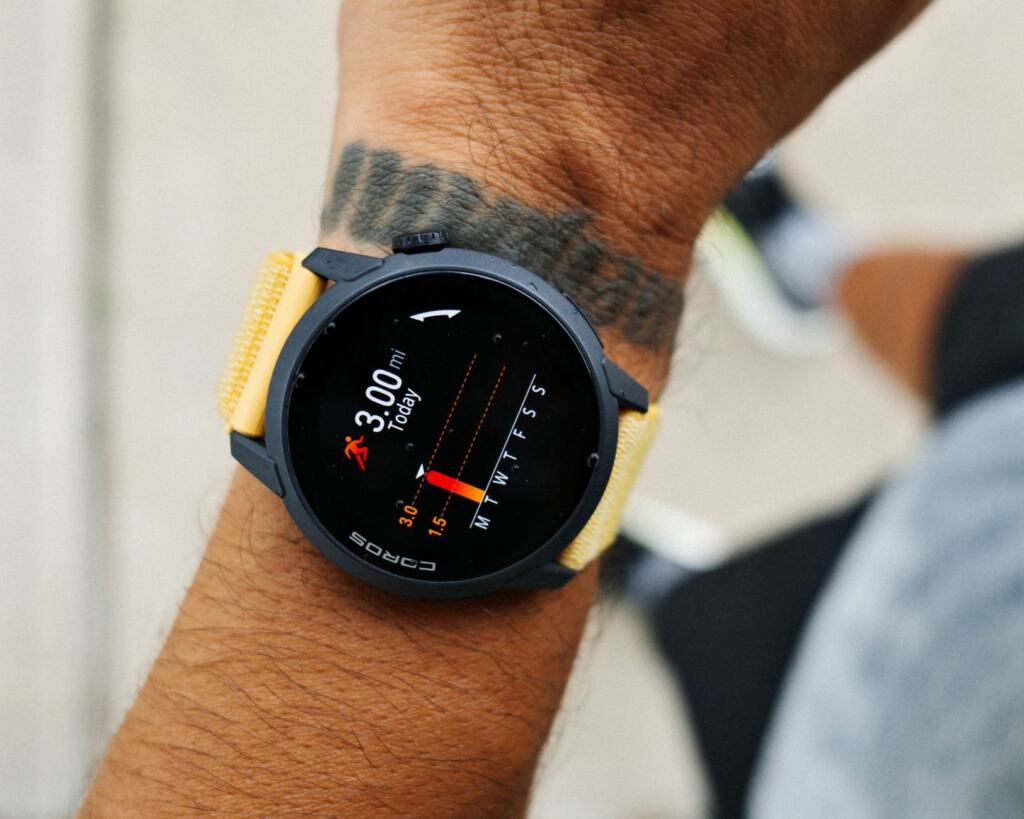
Watches and wearables estimate VO2 max from heart rate. SuperTri notes that this may not be 100% accurate, but if you compare your readings over time the direction of change is informative. That is the sensible way to use one.
- Use it for direction. A steady rise or fall across weeks of readings from the same device tells you more than any single value.
- Be careful with absolute placement. If a watch score puts you just above or below a percentile boundary, the error range above is larger than the gap.
- Confirm big decisions with a lab. If a result will change a medical conversation or a major training plan, a direct test is the stronger evidence.
How much VO2 max can change
Training can shift VO2 max noticeably, and the starting point shapes the size of the gain. SuperTri offers a rough guide that an untrained athlete may improve by 15 to 20 percent, although it could be higher in some cases. People who already train hard should expect smaller steps.
Everyday activity also shows up in the number. In the PubMed Central study, adults who met the recommended 150 minutes a week of moderate exercise had approximately 10% higher VO2 max than their counterparts. That is a group comparison, not a promise about what any individual will gain.
Interval work for people who are already active
Harvard Health describes high-intensity interval training as a fast and effective way to increase VO2 max, even for people who are already active, when done several times per week. The wording matters: hard intervals suit someone with a base of regular exercise, and they sit on top of easier sessions. They do not replace them. Matching interval effort to your heart rate zones keeps the hard days hard and the easy days easy.
Choosing a goal that fits
Choose the target by your starting point. A newcomer to exercise gains most by building regular moderate activity, and the percentile will usually climb without any special programme. An experienced runner gains most from adding structured intervals and then checking whether the watch trend, not a single reading, follows.
If your routine is mostly walking, the energy side of the story is covered in How Many Calories Do You Burn Walking? A Simple, Accurate Way To Calculate Calories Burned (2026 Guide) – Bioconnected.
Frequently asked questions
How long does a maximal VO2 max test take?
Harvard Health describes a maximal exercise test as intense but relatively short, between 10 and 20 minutes in total.
Can losing weight raise my VO2 max?
Yes, for the relative score. Harvard Health explains that because relative VO2 max is measured relative to your weight, simply losing weight can boost it.
Does a higher VO2 max mean lower disease risk?
It is associated with lower risk. Harvard Health reports that increasing VO2 max is associated with a reduced risk of heart disease, diabetes, cancer and stroke, which describes an association, not proof of cause.
Should I trust a percentile calculator?
Use it as a guide. The University of Kansas Medical Center bases its calculator on ACSM guidelines but says its algorithm is under peer review and its results are estimates only.