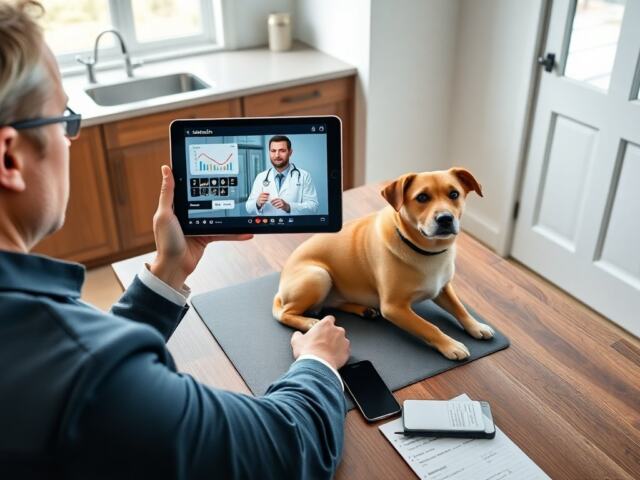
AI tools in healthcare find patterns in clinical and operational data, then give a person a prediction, summary or draft to review. They help most on narrow, well-defined tasks that are tested locally and monitored after launch.
This guide belongs to our wider coverage of digital health. For background on data that patients record themselves, see what is patient generated health data.
How the tools work, from data to decision
Most healthcare AI follows the same chain: records go in, a model produces an output, and a person acts on it or overrides it. Knowing the stages makes it easier to see where a tool can fail.
- Data in. Tools draw on medical history, lab results and current vitals, on radiological images, and on free text such as patient portal messages.
- Model. Deep learning models read images, prediction models estimate risk, and language models summarise or draft text.
- Output. The result appears as a flag, a risk estimate, a highlighted passage or a drafted note inside the clinician’s usual screen.
- Human review. A clinician confirms, edits or rejects the output. Tools that highlight information for a physician keep the decision with that physician.
- Monitoring. Performance has to be checked after deployment, because the data a model sees changes over time.
The final stage is the one most often neglected, and it is the focus of the regulatory and risk sections below. First, the clinical and operational uses show what this chain looks like in practice.
Clinical uses: imaging, decision support and prediction
Imaging and diagnostics
Imaging is the clearest clinical use. According to Alation’s overview of healthcare AI use cases, deep learning models can analyse radiological images such as X-rays, MRIs and CT scans to help radiologists spot subtle abnormalities. The tool narrows attention rather than issuing a diagnosis, so the radiologist remains the decision-maker. This arrangement suits departments that want a second look at images without changing who signs the report.

Clinical decision support and predictive analytics
Clinical decision support tools put suggestions in front of a clinician at the point of care, drawing on the patient’s record. Predictive analytics is a related approach that turns historical patient data into a risk estimate. The same Alation overview describes models that analyse medical history, lab results and current vitals to predict the likelihood of hospital readmission after discharge. A care team can use that estimate to decide who needs closer follow-up. It should be treated as a prompt for review, not a verdict on a patient.

Operational uses: documentation, messages and automation
Much of the measurable benefit so far is in administrative and documentation work rather than diagnosis. The American Medical Association’s report on health systems using AI gives several examples:
- Ambient scribes. The Permanente Medical Group’s AI scribes saved most of the physicians using them an average of one hour a day at the keyboard.
- Inbox support. Ochsner uses AI to highlight essential information in patient portal messages so physicians can read them more closely.
- Process automation. Geisinger has saved almost 500,000 hours through automation since 2019.
These are health-system reports, not controlled trials, so treat the figures as indications of what is achievable rather than guaranteed returns. The averages also apply to most users, not every user, which is a reason to pilot with a mixed group of clinicians before a wider rollout.
Many of these tools live inside the electronic health record. Epic, an EHR vendor, describes generative AI that integrates directly into the record. That placement matters because an output that appears in the clinician’s normal workflow is far more likely to be used than one in a separate application. For a plain definition of the record systems involved, read What Are Electronic Health Records? A Clear Definition, Key Benefits, And Why They Matter In 2026 – Bioconnected.
Use areas compared
The table groups the uses above by what the tool does and how a team should approach each one.
| Use area | What the tool does | Planning use |
|---|---|---|
| Imaging support | Analyses X-ray, MRI and CT images to help radiologists spot subtle abnormalities | Keep the radiologist as the reader of record and compare tool flags with local findings |
| Readmission prediction | Estimates readmission likelihood from history, labs and vitals | Use to prioritise follow-up, not to decide eligibility for care |
| Ambient documentation | Drafts notes so physicians spend less time at the keyboard | Pilot with a mixed group of users and measure time saved locally |
| Message triage support | Highlights essential details in portal messages | Keep a physician reading every message the tool touches |
Figures and examples in this comparison come from Alation and the American Medical Association.
Risks that shape how tools are deployed
Performance drift
A model that works at launch can get worse. The FDA discussion paper as reported by RAPS lists changes in clinical practices, patient demographics, data inputs and healthcare infrastructure as causes of degraded performance. This is why validation at launch alone is not enough, and why monitoring belongs in the budget from the start.
Testing that does not match real use
The same discussion paper notes that many AI-enabled medical devices are assessed mainly through retrospective testing or static benchmarks, and these may not predict real-world behaviour. For a hospital, the implication is practical: results published for a tool are a starting point, and local testing, such as running the tool quietly alongside clinicians before it influences care, gives better evidence of fit.
Capacity to deliver
Ambition often outruns resources. According to the AMA report, nearly 90% of health system executives rate digital and AI transformation as a high or top priority, yet 75% say their organisations cannot deliver on it, and 51% cite budget constraints. Smaller teams should choose one well-bounded problem rather than several at once.
Regulation and oversight
AI-enabled medical devices are an active focus for the FDA. Its Center for Devices and Radiological Health released a discussion paper seeking input on methods for assessing and evaluating them, with a comment deadline of 1 December 2025, according to RAPS. The paper frames safety and effectiveness as something to assure across the total product life cycle, both before and after deployment. For buyers, this means asking vendors how performance is tracked after go-live, not only how it was tested before.
Professional bodies are shaping expectations too. The AMA’s advocacy principles address oversight, disclosure, physician liability for AI-enabled technologies, and data privacy and cybersecurity. Organisations should settle who is accountable for each of these before a tool reaches patients.
Ethical use in practice
Ethical use comes down to transparency and keeping people in the loop. Atlantic Health, for example, maintains informed consent and offers patients the option of receiving AI-enabled care or not, as described by the AMA. Few organisations will copy that model exactly, but it shows that disclosure can be built into care rather than left to a policy document.
Three habits follow from the evidence above:
- Disclose what the tool does. Staff and patients should know when AI shaped an output, in line with the disclosure principle the AMA advocates.
- Keep a named human accountable. Liability for AI-enabled technology is an open concern, so a clinician should review high-stakes outputs.
- Protect the data. Privacy and cybersecurity are named oversight areas, so involve compliance staff from the first pilot.
A sensible rollout sequence
- Define one problem. Pick a narrow task, such as note drafting or readmission follow-up, and decide what success looks like.
- Test on local data. Retrospective benchmarks may not predict behaviour in your setting.
- Run quietly first. Let the tool produce outputs without influencing care, then compare them with clinician decisions.
- Pilot with clinicians. Gather structured feedback and measure time or outcomes against the current baseline.
- Monitor and revalidate. Plan staff time and budget for ongoing checks, since drift is a known cause of degraded performance.
Teams that follow this sequence tend to find problems while the tool is still low-stakes, which is the main reason to resist skipping the quiet-run step.
Frequently asked questions
Do vendor claims about time savings count as proof?
They are a useful lead, not proof. Epic, for instance, reports that nurses write end-of-shift notes 85% faster with its AI for clinicians, but that is a vendor-reported result. Measure the effect with your own staff and workflows before building a business case on it.
Does a HIPAA-compliant label settle privacy concerns?
No. Epic describes a HIPAA-compliant pipeline that incorporates language models into its EHR, which is relevant to a privacy review but does not replace one. Your organisation still needs its own assessment of how data flows, who can see outputs and how access is logged.
Will patients be told when AI is part of their care?
It depends on the organisation. Atlantic Health maintains informed consent and lets patients choose whether to receive AI-enabled care. Where no such policy exists, patients can reasonably ask how AI is used in their care and who reviews its outputs.