| What shapes the number | Supported detail | Planning use |
|---|---|---|
| Who you are | VO2 max varies by age, sex, genetics, training status, body composition and health condition. | Compare yourself with people of your own age and sex, not with a universal cutoff. |
| Units | Scores are expressed as ml of oxygen per kg of body weight per minute (ml/kg/min). | Only compare scores reported in the same units. |
| Watch estimate | Wearable estimates may differ by roughly 10 percent from lab testing. | Use the watch for direction of travel, not for a precise category. |
| One score or many | A single VO2 max number is less useful than watching whether your fitness is improving. | Re-check under similar conditions and judge the trend. |
Figures and conditions come from Franciscan Health’s VO2 max guidance and the University of Kansas Medical Center fitness ranking page.
What is a good VO2 max? It depends on your age and sex, because no fixed cutoff separates good from bad. Compare your score with peers, then judge your own trend over time.
If you track fitness on a wrist device, our guide on how to use a fitness tracker covers the wider setup, while this page focuses on what the VO2 max figure means and what to do about it.
Reading your score
A good VO2 max is relative, not absolute. A sports-performance resource, Supertri, states that there is no defined good or bad value because the number is relative to your age and sex. In practice that changes how you should use any chart or app ranking: the useful question is how you compare with people like you, and whether you are moving in the right direction.
Franciscan Health lists the factors behind the spread between people: age, sex, genetics, training status, body composition and health condition. Several of these are outside your control, which is why a friend’s higher score is a weak reason to feel unfit. Training status is the one you can change.
- Use peer comparisons as a rough guide. Age and sex bands are a sensible reference, but they describe groups, not you. Genetics and body composition can place a healthy, active person anywhere within a band.
- Prefer your own history. Franciscan Health notes that watching whether your fitness is improving is more useful than a single number. A rising score across repeated checks tells you more than one reading against a chart.
- Keep conditions steady. The same test, the same device and similar preparation make a change in the number more likely to reflect fitness rather than the circumstances of the day.
The University of Kansas Medical Center page also makes clear that its ranking figures are estimates only, so treat any chart category as a starting point for a conversation about goals, not as a diagnosis.
What a watch estimate means for your score
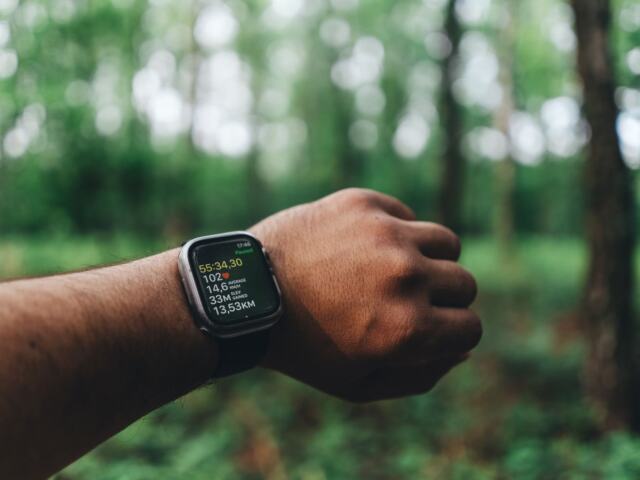
A watch estimate is a model of your VO2 max, not a measurement of it. Supertri explains that watches and wearables can automatically provide an estimate based on your heart rate, and that it may not be completely accurate. Empirical Health describes how the Apple Watch estimates VO2 max without a respiratory mask, using heart rate and GPS data.
That matters for how you read it. Franciscan Health says wearable estimates may differ by roughly 10 percent from lab testing. An error of that size makes a watch poor at telling you which age-and-sex category you belong to, but it can still show whether you are drifting up or down, provided you wear the same device and run in similar conditions.

Here is how to turn that into decisions:
- Trust the trend over weeks. If your watch figure climbs after a block of consistent training, the direction is meaningful even if the absolute value is off.
- Do not mix sources. A lab result and a watch figure are different kinds of number. Comparing one with the other will mostly show the gap between methods.
- Pay for a lab test only if you need accuracy. If you want a direct baseline, the lab route described below is the better tool.
VO2 max is not the only number a watch reports. Heart rate variability is another, and the guide What’s A Good Heart Rate Variability Range? Practical Targets And How To Improve HRV In 2026 – Bioconnected sets out practical ranges for it, which complements the trend-watching approach here.
Choosing a test
Lab testing on a treadmill or bike
The lab test is the benchmark. According to Supertri, the test is typically a maximal progressive test on a treadmill or cycle that becomes increasingly harder until you can no longer continue, with a facemask measuring your breath. The University of Kansas Medical Center page adds that maximal exercise testing should be conducted on a treadmill according to ACSM guidelines, and it describes VO2 max as the gold standard of measurement in aerobic fitness scoring.
Choose this route when you want a trustworthy baseline, or when you plan to judge a watch against something direct. Because the test is maximal, it asks for all-out effort, so it is not a casual option for everyone.

Field tests: the Cooper test and walking alternatives
Field tests estimate VO2 max from performance rather than from gas analysis. Supertri names the Cooper test, a 12-minute run, and the Rockport fitness walking test as examples. The Cooper test suits someone who can sustain a hard, steady run and wants a repeatable benchmark without a laboratory. The Rockport walking test is the more natural fit for people who would rather not run.
Which to pick
- Lab test: best when accuracy matters or you need a reference point.
- Field test: best when you want a repeatable check on your own schedule and can give a committed effort.
- Watch estimate: best for passive, continuous tracking when a rough trend is enough.
Improving VO2 max
Regular exercise is the lever, and the intensity you start at should match your current fitness. Franciscan Health stresses that higher-intensity intervals can be effective but are not the right starting point for everyone, so build up gradually.
- Add strength training. Franciscan Health recommends two or more days per week of strength training if you are able. It is a sensible companion to aerobic work rather than a replacement for it.
- Start with short intervals. Beginners may want to start with 30-second to 60-second intervals, then lengthen the hard efforts as they adapt.
- Treat the Norwegian 4×4 as a progression target. In research settings it is described as a 10-minute warm-up, then four 4-minute intervals at about 85% to 90% of estimated max heart rate, with about 3 minutes of recovery between them, up to 3 times per week. Up to 3 times is a ceiling, not a goal to hit straight away.
Pick the first option that fits your current routine and re-check your score under similar conditions. If the watch trend is flat after sustained training, that is a signal to review how consistently you are doing the harder sessions, not to chase a bigger number from a different device.
Everyday walking is a separate measure from VO2 max, and How Many Steps Should You Walk Each Day? Simple Targets and Evidence-Based Guidance For 2026 – Bioconnected covers daily step targets that can sit alongside structured training.
What VO2 max actually measures
VO2 max is maximal oxygen consumption during aerobic exercise. The University of Kansas Medical Center calls it the gold standard of measurement in aerobic fitness scoring, which is why labs and fitness rankings are built around it. It is a single summary of aerobic fitness, which explains why one number can be useful for tracking but cannot describe everything about your health.
Because it is scaled to body weight, the score reflects oxygen use relative to your size. The same source notes that age, along with other factors, can also influence an individual’s score, so interpretation always needs context. This is the reason the earlier advice leans on peer comparison and personal trend rather than a single threshold.
Frequently asked questions
Does VO2 max fall as you get older?
It typically drops as a person ages, according to Franciscan Health, but regular exercise can slow the decline.
What units is VO2 max reported in?
Millilitres of oxygen consumed per kilogram of body weight per minute, written ml/kg/min, as set out by the University of Kansas Medical Center.
How reliable are online VO2 max ranking calculators?
Treat them as approximate. The University of Kansas Medical Center page bases its calculator on the ACSM Guidelines for Exercise Testing and Prescription (9th edition) and says the figures are estimates only.