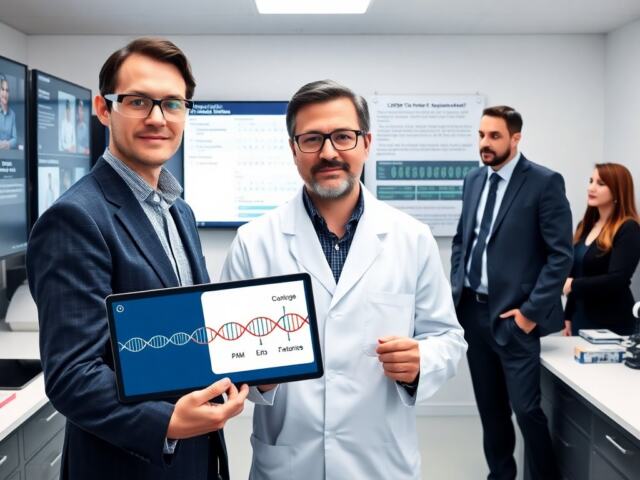
benefits of crispr appear across medicine, agriculture, and industry. Scientists show how CRISPR cuts DNA at chosen sites. Researchers insert, remove, or fix genes. The tool speeds research and reduces cost. Policymakers and companies invest in scaled programs. Patients, farmers, and manufacturers report early gains. This article explains clear, practical benefits of crispr for health, food, and the economy.
Key Takeaways
- CRISPR technology enables precise, fast, and cost-effective gene editing, revolutionizing research and application across multiple fields.
- In medicine, CRISPR offers promising therapies for blood disorders, cancer, and rare genetic diseases by directly correcting faulty genes and enhancing immune responses.
- CRISPR accelerates infectious disease control through rapid diagnostics, adaptable vaccines, and innovative vector management strategies.
- In agriculture, CRISPR improves crop resilience and nutrition without introducing foreign DNA, supporting food security and climate adaptation.
- Industrial uses of CRISPR enhance production efficiency and environmental remediation by engineering microbes to reduce waste and reliance on fossil fuels.
- Clear ethical guidelines and regulatory oversight ensure the safe, responsible development of CRISPR applications, balancing innovation with public trust.
What Is CRISPR And How It Works — A Concise Plain‑English Overview
CRISPR refers to a set of molecular tools. Scientists use those tools to edit genes. The system relies on an enzyme that cuts DNA. A guide RNA directs the enzyme to a specific sequence. Cells then repair the cut and change a gene. Researchers design guide RNAs to target disease genes or crop traits. Labs now use CRISPR to run many edits in parallel. Companies scale the technique for therapies, crops, and enzymes. The clear result is faster, cheaper, and more precise gene change. This clarity explains many benefits of crispr noted below.
At a practical level, CRISPR workflows combine molecular design, delivery methods, and cellular repair pathways. Delivery can be ex vivo (cells edited outside the body then returned) or in vivo (direct delivery to tissues). Scientists also develop base editors and prime editors that change single DNA letters without cutting both strands, reducing error risk in some applications. Together, these developments expand the range of conditions that can be targeted and the precision with which edits are made—key drivers of the real-world benefits of crispr.
Transforming Medicine: Life‑Changing Therapeutic Benefits
Clinicians test CRISPR in clinical trials worldwide. The technique allows direct correction of mutated genes. Many trials target blood disorders, like sickle cell disease and beta thalassemia. Early results show durable remission and reduced symptoms. Researchers also use CRISPR to make immune cells that attack tumors. These engineered cells improve response rates in some cancers. The tool shortens the path from discovery to human testing. That speed reduces patient wait times and lowers development cost. Investors note the economic benefits of crispr in building new treatment platforms and companies.
Beyond single-gene fixes, CRISPR supports personalized medicine by enabling rapid functional testing of patient-specific mutations and by generating cellular models for drug screening. For patients, that can mean faster diagnosis and more tailored treatment choices. For health systems, the potential benefits of crispr include lower lifetime treatment costs for conditions that previously required chronic care, and the ability to move promising therapies from lab to clinic on timelines that were previously impractical.
Gene Therapies, Cancer Treatments, And Rare Disease Cures
Researchers apply CRISPR to fix single-gene disorders. They correct mutations that cause blindness or metabolic disease. Clinics deliver edits ex vivo or directly into tissues. Trials for muscular and liver disorders show measurable gains. In oncology, scientists reprogram T cells to better find tumors. Those edits increase tumor killing and patient survival in early studies. For rare diseases, CRISPR cuts development time and cost. Patient groups fund small, targeted trials. Those trials deliver hope and concrete clinical benefits of crispr for families with rare conditions.
Practical benefits here include the reduction in treatment burden—for example, converting lifelong therapy regimens into one-time or short-course interventions in some cases—and the ability to address conditions that previously had no effective therapies. Importantly, ongoing research focuses on improving safety, delivery, and durability so that the potential of CRISPR-based gene therapies can translate into accessible standard-of-care options.
CRISPR In Infectious Disease Prevention, Vaccines, And Diagnostics
Public health teams use CRISPR to speed diagnostics. The method detects viral RNA with high sensitivity. Clinics deploy CRISPR-based tests at point of care. Developers also design vaccine platforms that use edited viral genes. Those platforms permit rapid update when pathogens change. In vector control, researchers edit mosquitos to reduce disease transmission. Trials test gene drives and localized suppression strategies. These approaches reduce disease burden and protect communities. Each application highlights practical, measurable benefits of crispr for infection control and public health.
Operational advantages include faster outbreak response due to rapid-test design, lower per-test costs for some diagnostic formats, and flexible vaccine platforms that can be adapted as pathogens evolve. In vector control and environmental strategies, CRISPR-driven approaches can complement traditional methods (insecticides, habitat control) and offer targeted, potentially longer-lasting reductions in transmission when used with careful monitoring and community engagement.
Boosting Agriculture And Food Security With Precise Editing
Farmers and breeders use CRISPR to make crops stronger and more nutritious. Scientists edit genes to increase drought tolerance and pest resistance. The edits often avoid introducing foreign DNA. Regulators in several countries treat some edits like traditional breeding. That policy shortens the path to market. Companies create varieties with higher yield and shelf life. Food processors benefit from reduced waste and consistent supply. Smallholder farmers in trials report better harvests. Those improvements point to major benefits of crispr for food security and climate resilience.
Additional benefits of crispr in agriculture include faster breeding cycles, more precise trait stacking without linkage drag, and the potential to reduce chemical inputs by enhancing innate plant resistance. These outcomes support more sustainable production systems and can help stabilize supply chains, particularly in regions facing changing climate conditions. Breeding programs can more rapidly respond to emerging pests or nutrient deficiencies, improving food availability and nutritional quality.
Industrial Biotechnology, Environmental Remediation, And Bioeconomy Uses
Manufacturers use CRISPR to improve microbes for production. Engineers edit yeast and bacteria to make chemicals and materials more cheaply. That change cuts energy use and waste in many processes. Environmental teams edit microbes to break down pollutants in soil and water. Pilot projects show faster degradation of specific contaminants. Bio-based materials companies design organisms to produce fibers and adhesives. Those products reduce reliance on fossil feedstocks. Each case delivers measurable economic and environmental benefits of crispr through lower cost and reduced emissions.
In practice, benefits of crispr in industry include higher product titers, fewer downstream purification steps, and shorter development timelines for bioprocesses. For environmental remediation, edited organisms can be tailored for specific substrates and conditions, offering targeted cleanup options that minimize collateral impacts. Together, these applications support a growing bioeconomy in which biological manufacturing and remediation reduce resource intensity and open new sustainable value chains.
Ethical, Safety, And Regulatory Considerations To Weigh
Policymakers set rules for gene editing use. Regulators evaluate safety, efficacy, and social impact. Scientists report off-target edits and work to reduce them. Ethics boards review germline editing and set limits. Many countries ban inheritable human edits while allowing somatic therapies. Transparent trials and public engagement inform policy. Companies must show data on long-term effects. Regulators require monitoring after approval. Clear regulation helps realize benefits of crispr while managing risk and protecting public trust.
Responsible deployment includes robust preclinical safety testing, post-approval surveillance, equity in access to therapies and agricultural improvements, and meaningful public consultation. Addressing ethical concerns—such as potential ecological effects of gene drives, informed consent in vulnerable populations, and fair distribution of benefits—strengthens the conditions under which the benefits of crispr can be broadly realized and sustained.